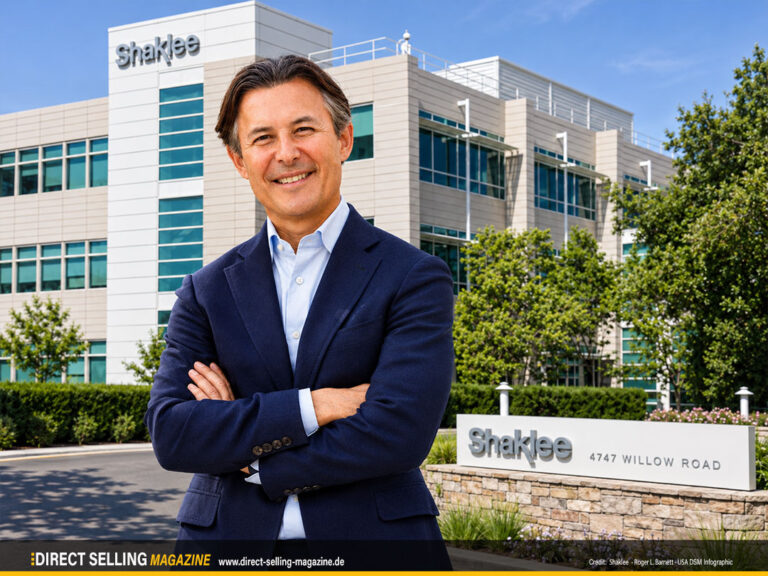
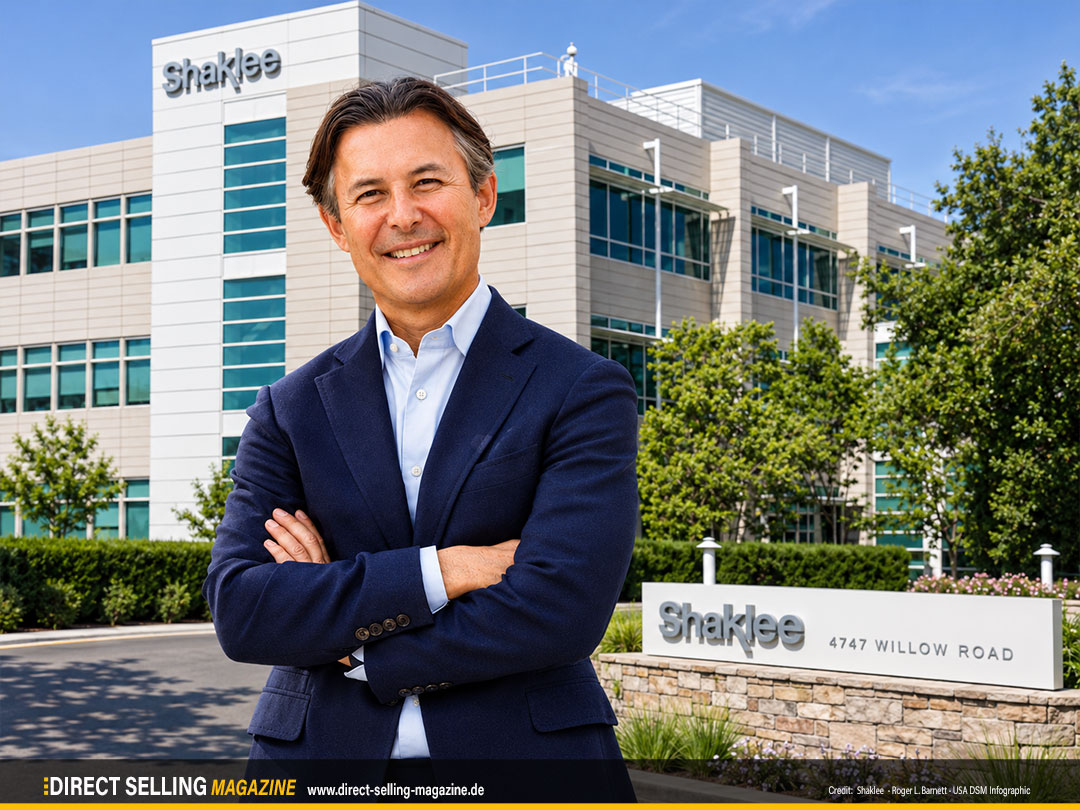
In early November 2026, direct selling company Shaklee, under Chairman and CEO Roger Barnett, acquired Isagenix, the network marketing company founded in 2002 by Jim and Kathy Coover, or substantial parts of its assets. At its peak, Isagenix generated revenue of just under $1 billion, and in 2023 it was saved from collapse only by a recapitalization. Shaklee, whose roots go back to 1915, is thus continuing its acquisitions within the industry, following its purchase of Modere’s trademarks, patents, and formulations in May 2025.
Shaklee welcomes Isagenix
On November 5, 2026, Isagenix CEO Sharron Walsh informed the company’s international distributors of the acquisition by Shaklee in a “Global Associates Call.” This is based on consistent accounts from within the distributor community; as of press time, neither company had issued a press release. The partner platform Isagenix Business carries the notice “Shaklee welcomes Isagenix” and links to a set of FAQs that can be accessed only after logging in.
Isagenix compensation plan to be phased out
According to these accounts, the Isagenix compensation plan is to be phased out, distributors are to be transferred to Shaklee’s compensation system, and some of the products are to be integrated into the Shaklee lineup. Within the distributor community, the deal is described as the acquisition of “certain assets.” The key terms of the transaction have not been published: whether Shaklee is acquiring all of the company’s shares or only individual assets, the purchase price, the treatment of legacy debt, the future of the minority stake held by founders Jim and Kathy Coover, and the timeline.
Shaklee and the outlook for Isagenix associates
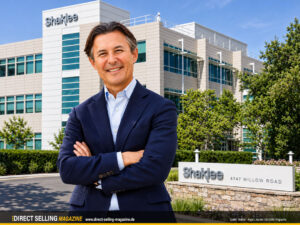
Shaklee, headquartered in Miami, has been led since 2004 by Roger L. Barnett as Chairman and Chief Executive Officer. By its own account, the company reaches more than two million members and brand ambassadors in North America and Asia, plus Australia and New Zealand; that figure includes customers with member status and should not be equated with active, commission-eligible distributors.
How Shaklee handles acquired sales organizations is illustrated by the Modere case: after the acquisition in May 2025, Modere products were being resold through the Shaklee network within days, and Barnett explicitly offered former Modere distributors a “new home” at Shaklee. For Isagenix associates, this opens up the prospect of continuing their business within an established company with a broader product range.
What matters are the terms under which customers, teams, qualifications, and commission entitlements transfer into the Shaklee system, in particular whether organizational structures built up over many years will be recognized if the Isagenix compensation plan is in fact phased out. No binding, publicly available transition rules exist.
Which Isagenix markets will continue and be taken over is not known
With Isagenix, Shaklee continues its acquisitions in the industry. In 2016, the company took in the distributors of LiveSmart 360, a company that had shut down. In May 2025, through a subsidiary, it acquired “substantially all of the business” of the previously discontinued direct selling company Modere: trademarks, patents, formulations, the production and testing equipment of its North American manufacturing operation, and inventory, plus the worldwide exclusive license for Liquid BioCell Collagen. Former Modere CEO Asma Ishaq has headed a dedicated collagen division ever since.
Isagenix adds established customer relationships with recurring orders and international structures: in 2020, the company cited 26 markets, including Germany, Austria, and Switzerland. Both companies make protein shakes, nutritional supplements, and collagen products and operate subscription models; accordingly, their purchasing, production, and logistics overlap. Which Isagenix markets will continue and be taken over is not known.
The product portfolios: weight management and longevity
Isagenix built its market position on systematically assembled weight management programs, first and foremost the 30-Day System featuring the IsaLean protein shake, the Cleanse for Life beverage, and the Ionix Supreme tonic; sports nutrition, energy shots, Collagen Elixir, and Adaptogen Elixir were added later.
Shaklee positions itself in the longevity segment under the tagline “Live Age Free.” Its lineup ranges from Vitalizer and the personalized supplement program Meology to Life Shake and Vivix, through to Sparkling Protein, launched in October 2025. According to industry reports, Liquid BioCell Collagen already ranks among Shaklee’s ten best-selling products; the Modere lines continue under the label “powered by Shaklee.”
The two product ranges overlap in the protein shake, nutritional supplement, and collagen categories. Shaklee has not yet disclosed which Isagenix products, formulations, and product names will be retained, or on what purchasing terms.

Isagenix: rise, peak, and decline
Isagenix launched in March 2002 with six employees in a small office in the greater Phoenix area. John W. Anderson, who as a white-label supplier had developed more than 2,300 nutritional supplement and diet products for other companies, brought Jim and Kathy Coover out of retirement: Jim Coover designed the compensation plan, and Kathy Coover contributed her experience as a “top earner” at three network marketing companies. In 2005, the Coovers acquired majority ownership from Anderson, who stayed on as “Master Formulator.”
Growth was rapid: according to figures certified by Direct Selling News (DSN), revenue stood at $448 million in 2013 and $725 million in 2014. In March 2016, Isagenix moved into its new headquarters in Gilbert, Arizona. Direct Selling Magazine reported revenue of $890 million for 2015, followed by $924 million in 2016.
Isagenix reached its peak in 2017 with revenue of $958 million, ranking 27th in the DSN Global 100 and falling just short of the billion-dollar mark. That same year, the company launched in Europe with 17,000 pre-registrations. By the end of 2022, according to company figures, 415 distributors worldwide had earned more than $1 million in cumulative commissions.
In 2020, Isagenix itself acquired Zija International
In January 2018, Jim Coover handed the CEO post to Travis Ogden and concentrated on chairing the board. In January 2020, Isagenix itself acquired competitor Zija International of Lehi, Utah, founded in 2005 by Ken Brailsford, co-founder of Nature’s Sunshine, and since 2017 the owner of the former mangosteen brand Xango.
Direct Selling Magazine ran the headline “Network Marketing Giant Isagenix Swallows Zija International.” In September 2020, Sharron Walsh, with the company since 2009, succeeded Ogden and launched the renewal initiative “Isagenix 2.0.” By then, Isagenix was no longer reporting certified annual revenue: at its own request, the company was already absent from the 2019 DSN ranking covering fiscal year 2018.
The turning point came in 2023. On February 27, 2023, Isagenix reached a restructuring agreement with its lenders, and on April 17, 2023, the recapitalization was completed: roughly $170 million in liabilities was eliminated. The Coovers contributed capital and debt forgiveness worth $95 million but lost majority control to an investor group. After a good two decades, Isagenix was thus no longer family-controlled; less than three years later, Shaklee becomes the next owner.
Isagenix revenue history in millions of US dollars
Year | Revenue | Source / Status | Note |
|---|---|---|---|
2013 | 448 | DSN Global 100 (certified) | Rank 29 |
2014 | 725 | DSN Global 100 (certified) | Rank 27; +62% year over year |
2015 | 890 | DSN Global 100 / DSM report | Rank 22 |
2016 | 924 | DSN Global 100 (certified) | Rank 26 |
2017 | 958 | DSN Global 100 (certified) | Rank 27; all-time high |
2018 onward | not reported | Isagenix has not reported figures to the ranking since 2019 | April 2023: approx. $170 million in debt eliminated |
Figures in millions of US dollars. Certified values are taken from the respective DSN Global 100 (the following year’s ranking, based on prior-year revenue and confirmed by the company via a Revenue Certification Form). Cumulative revenue since founding, according to company figures: $4 billion (February 2016), $5 billion (March 2017), $6 billion (May 2018).

Shaklee: more than a century of company history
Shaklee’s history goes back more than a century. In 1915, chiropractor Forrest C. Shaklee developed “Shaklee’s Vitalized Minerals,” which the company describes as the first multivitamin in the United States. In 1956, together with his sons Forrest Jr. and Raleigh, he founded Shaklee Products in Oakland, California, relying on direct selling from the outset.
In 1960 came Basic-H, one of the first biodegradable, phosphate-free household cleaners, a product that, according to the company, was carried aboard several Apollo missions and in 1990 was among the first official Earth Day products.
Shaklee went public in 1973
In the 1970s, revenue rose from $20 million to more than $320 million; Shaklee went public in 1973 and joined the Fortune 500 in 1982. By the company’s own account, Shaklee nutrition products accompanied the Voyager aircraft on the first nonstop flight around the world in 1986 and the record flight of the human-powered Daedalus in 1988; in 1987, Jacques Cousteau chose Shaklee cleaners for his research vessels Calypso and Alcyone.
In 1989, Japanese pharmaceutical group Yamanouchi acquired Shaklee for $395 million
In 1989, the Japanese pharmaceutical group Yamanouchi acquired the company for roughly $395 million and took it private. In 2000, Shaklee became the first company in the world to be certified climate neutral.
In 2004, Shaklee passed to the private equity firm Ripplewood Holdings and to Activated Holdings; Roger L. Barnett has led the company ever since, and it has since moved its headquarters from California to Miami. The DSN ranking listed $500 million for 2010, and DSN certified $844 million for 2014; the privately held company does not publish more recent audited annual revenue. In December 2025, Shaklee reported an average increase of 29 percent in the United States and Canada for November compared with the same month a year earlier, along with more than 200,000 new members within twelve months.
Shaklee revenue data in millions of US dollars
Year | Revenue | Source / Status | Note |
|---|---|---|---|
2003 | approx. 279 | Yamanouchi sale documents | US and Japan business (¥30.66 billion) |
2010 | 500 | DSN Global 100 (2011) | Rank 25 worldwide |
2011 | 515 | Company figure | eight markets |
2014 | 844 | DSN Global 100 (certified) | Rank 21 |
thereafter | not reported | no audited annual revenue published | Dec. 2025: +29% US/Canada in November; more than 200,000 new members in twelve months |
Figures in millions of US dollars. Shaklee is not publicly traded and does not publish audited financial statements. The company announcement of December 9, 2025, cites growth indicators, not annual revenue.

Roger L. Barnett: the man at the top of Shaklee
Roger L. Barnett has led Shaklee as Chairman and Chief Executive Officer since 2004. That year, Ripplewood Holdings and Activated Holdings, the Barnett family’s investment vehicle, acquired 81 percent of the company from the Japanese pharmaceutical group Yamanouchi for about $310 million. Barnett graduated from Yale College with honors, earned his law degree at Yale Law School, where he was a senior editor of the Yale Law Journal, and went on to earn an MBA at Harvard Business School.
He began his career at the investment bank Lazard Frères. He then organized an investor group that took control of the product sampling specialist Arcade and built the US company into a global provider, by its own account the largest in its industry. With Beauty.com, he founded and ran one of the first online retailers for cosmetics.
Beyond his own company, Barnett has represented the industry: he was elected Chairman of the World Federation of Direct Selling Associations (WFDSA), which represents more than 60 national direct selling associations. The World Economic Forum named him one of its “Global Leaders for Tomorrow,” and the National Committee on U.S.-China Relations admitted him as a Young Leader Fellow. Barnett serves on the Leadership Councils of the schools of public health at Harvard and Yale, on the University Council of Yale University, and on the advisory board of the Green Belt Movement, founded by Nobel Peace Prize laureate Wangari Maathai.
Under Barnett, Shaklee shifted its focus to longevity and began acquiring brands and sales organizations from within the industry: LiveSmart 360 (2016), Modere (2025), and now Isagenix. In April 2025, Forbes profiled the Shaklee chief under the headline “On Living Well, One Life Shake at a Time.”
Consolidation in US direct selling
With Isagenix, Shaklee brings the third sales organization of a competitor under its roof within ten years, after LiveSmart 360 and Modere. Isagenix also brings with it the sales organizations of Zija International and Xango, which Isagenix itself had acquired in 2020.
Editorial note: This report is Direct Selling Magazine’s continuously updated master report on Shaklee’s acquisition of Isagenix. New information on the purchase price, ownership structure, compensation plan, and product brands will be added with a date stamp once confirmed; individual news items over the course of the week will link to this report. Research and information status: November 7, 2026.
© Direct Selling Magazine – Digital Protect System